How Is Artificial Intelligence Changing Digital Marketing?
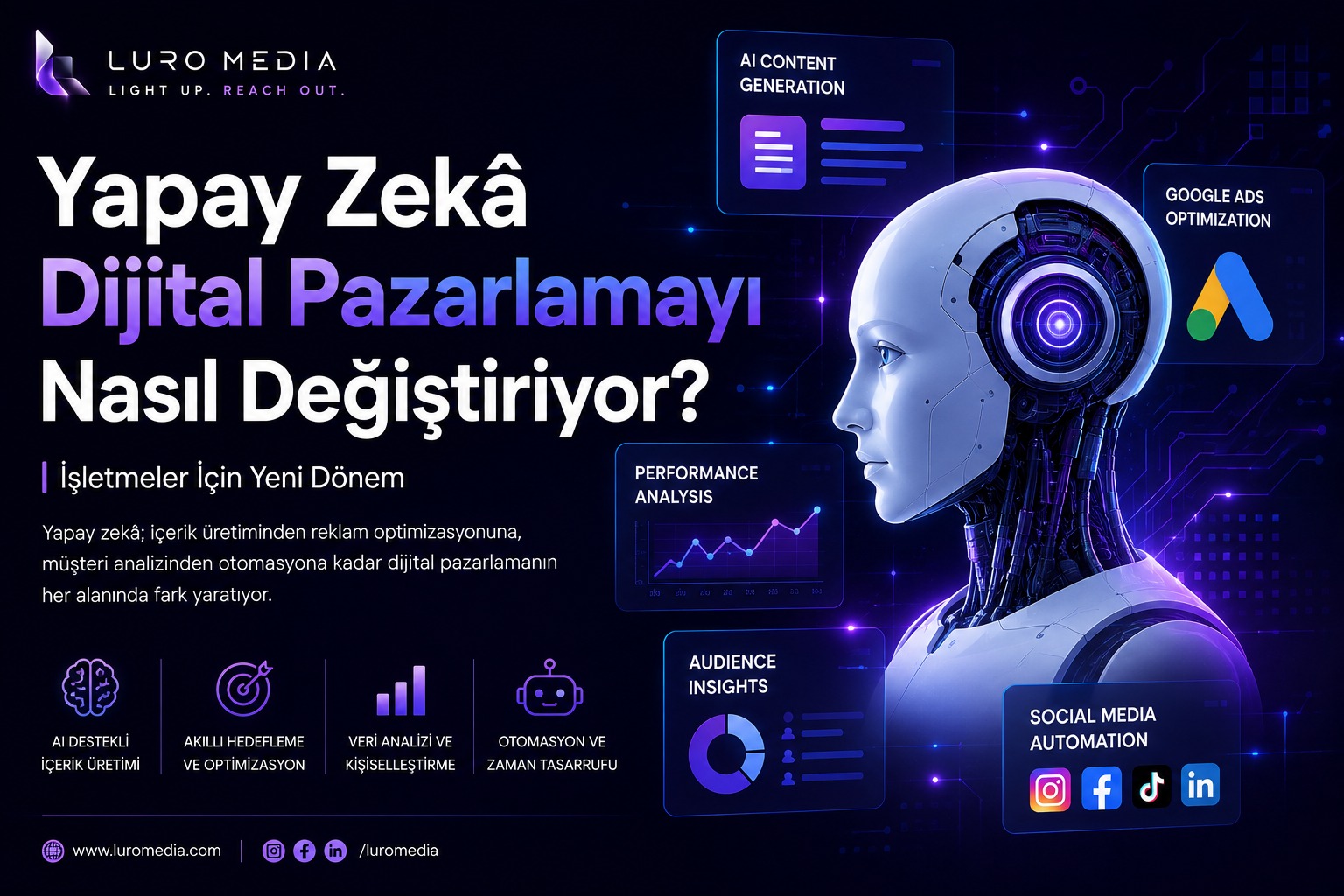
Artificial intelligence is no longer an experimental technology used only by technology companies. It is increasingly becoming part of content creation, advertising, analytics, social media management and marketing automation.
For businesses, this transformation is about much more than generating content faster. AI can help analyze large amounts of data, identify patterns in customer behavior, automate repetitive processes and support more personalized digital experiences.
However, using AI tools effectively is different from handing an entire marketing strategy over to automation. Successful digital marketing still requires a combination of technology, data, creativity and human expertise.
What Is AI in Digital Marketing?
AI in digital marketing refers to the use of artificial intelligence technologies to analyze data, create content, identify patterns, make predictions and automate selected marketing processes.
Many digital platforms already incorporate machine learning and AI technologies into their systems.
Search engines, advertising platforms, social media algorithms, recommendation systems, analytics platforms and chatbots are examples of technologies where AI can play an important role.
Where Can AI Be Used in Digital Marketing?
- Content ideation
- Copywriting and editing
- Image generation
- Video production
- Advertising copy
- Audience analysis
- Customer segmentation
- Data analysis
- Chatbots and customer support
- Email marketing automation
- SEO research
- Advertising optimization
- Personalized user experiences
The objective should not be to use every available AI tool, but to identify technologies that can genuinely support business and marketing objectives.
AI-Powered Content Creation
Content creation is one of the most visible applications of generative AI in marketing.
AI tools can assist with blog ideas, social media captions, advertising headlines, product descriptions, email content and video scripts.
This can accelerate production processes, particularly for brands that need to create content regularly.
However, AI-generated content should still be reviewed for accuracy, brand consistency, originality and relevance before publication.
Can AI Replace Human Content Creators?
AI can accelerate content production, but brand strategy, cultural context, creativity, original experiences and an understanding of human behavior continue to require human judgment.
A more useful question is therefore not whether humans or AI will win, but how human expertise and artificial intelligence can work together.
AI in Social Media Management
Social media management includes content planning, creative production, community management, analytics and audience research.
AI can support many of these processes by generating content ideas, creating caption variations, assisting with content calendars, analyzing performance and producing creative concepts.
Nevertheless, a brand's social media identity should not become completely automated. Brand voice, values and audience expectations should remain central to the strategy.
Google Ads and Artificial Intelligence
Digital advertising is one of the areas where machine learning is widely used.
Advertising platforms can use automated systems for bidding, ad delivery, targeting and campaign optimization.
Automation can process large amounts of campaign data, but it does not eliminate the need for strategy.
Conversion goals, campaign structure, budgets, landing pages, creative direction and performance analysis still require careful planning.
Meta Ads and Artificial Intelligence
Meta's advertising ecosystem also uses advanced algorithms to optimize advertising delivery and campaign performance.
Advertisers still need to provide strong creative assets, clear campaign objectives and reliable conversion data.
AI tools can also help teams generate more creative variations for testing, while human teams maintain control over positioning, messaging and offers.
AI for Audience Analysis
Understanding the target audience is fundamental to marketing.
AI can help identify behavioral patterns within large datasets and support the creation of customer segments.
This can enable marketers to develop more relevant communication strategies for different groups instead of delivering exactly the same message to everyone.
Personalized Marketing
AI-powered systems can support personalized experiences based on user behavior.
An e-commerce website, for example, may recommend products based on previous browsing behavior, while an email campaign may deliver different content to different customer segments.
Personalization should always be implemented responsibly, with appropriate consideration for privacy and user preferences.
AI and SEO
AI can support SEO professionals with keyword clustering, content research, competitor analysis, content structures and large-scale data analysis.
However, publishing large quantities of automatically generated content is not a complete SEO strategy.
Useful content, search intent, technical SEO, website quality and long-term authority remain important.
AI Chatbots for Websites
AI-powered chatbots can help websites provide basic customer support, answer common questions and guide visitors toward relevant services.
They can also provide assistance outside regular business hours.
For more complex customer requests, businesses should consider providing an easy transition from automated support to human assistance.
AI Image and Video Generation
Generative AI can help marketing teams develop visual concepts, advertising creatives, blog covers, storyboards and social media content.
AI can also support video workflows through script development, subtitles, voice generation, editing assistance and content repurposing.
Brand consistency remains important. Logos, typography, colors and visual identity should remain consistent across AI-assisted creative work.
Marketing Automation and AI
AI can support repetitive marketing activities such as email workflows, customer segmentation, lead evaluation, reporting and behavior-triggered campaigns.
Automation can give marketing teams more time to focus on strategy, creative development and customer experience.
AI-Powered Data Analysis
Digital marketing produces significant amounts of data from websites, advertising campaigns, social platforms and customer interactions.
AI can help teams identify trends and patterns within these datasets more efficiently.
However, data still needs to be interpreted within the context of actual business objectives. A metric increasing does not automatically mean that business performance has improved.
Benefits of AI in Digital Marketing
- Accelerates repetitive processes
- Supports large-scale data analysis
- Assists content production
- Enables faster creative variation
- Supports customer segmentation
- Enables personalized experiences
- Reduces operational workload
- Accelerates testing and optimization
What Are the Risks of AI?
- Generating inaccurate information
- Producing repetitive content
- Losing a distinctive brand voice
- Reducing human oversight
- Privacy concerns
- Copyright and usage-right issues
- Over-automation
- Focusing on tools instead of strategy
Professional AI workflows should therefore include human review and quality control.
Will AI Replace Digital Marketing Agencies?
AI is likely to change how digital agencies work, but digital marketing involves much more than content production.
Brand positioning, strategy, creative direction, budgeting, customer communication, cultural understanding and business objectives continue to require human expertise.
Strong agencies can use AI to improve their workflows while maintaining human strategic and creative control.
Human + AI: A Stronger Marketing Model
The future of digital marketing is likely to involve collaboration between human expertise and artificial intelligence.
AI can provide speed, processing capacity and scalable production.
Humans contribute strategy, creativity, empathy, cultural understanding and brand perspective.
Combining these strengths can help marketing teams become more efficient without sacrificing quality.
AI-Powered Digital Marketing with Luro Media
At Luro Media, we view artificial intelligence as a technology that supports human creativity rather than replaces it.
Modern technologies can support research, content production, creative development, analytics and optimization while strategic decisions remain aligned with the brand's actual objectives.
We approach social media management, Google Ads, Meta Ads, SEO, web design and corporate identity as connected components of the same digital ecosystem.
Our goal is not to use AI simply because it is a trend, but to apply technology where it can contribute to more efficient, measurable and sustainable digital marketing.
Conclusion
Artificial intelligence is changing the way digital marketing teams work.
From content creation and advertising optimization to analytics and automation, AI can make many processes faster and more data-driven.
Technology alone, however, does not create a successful marketing strategy.
The strongest model combines artificial intelligence with human creativity, strategic thinking and professional oversight.